How Crelis works
The independent authority layer between AI and the real world
Before an AI agent takes a consequential action, Crelis evaluates it against policy and decides — allow, require human approval, escalate, or block — then issues or withholds the execution visa and records the evidence.
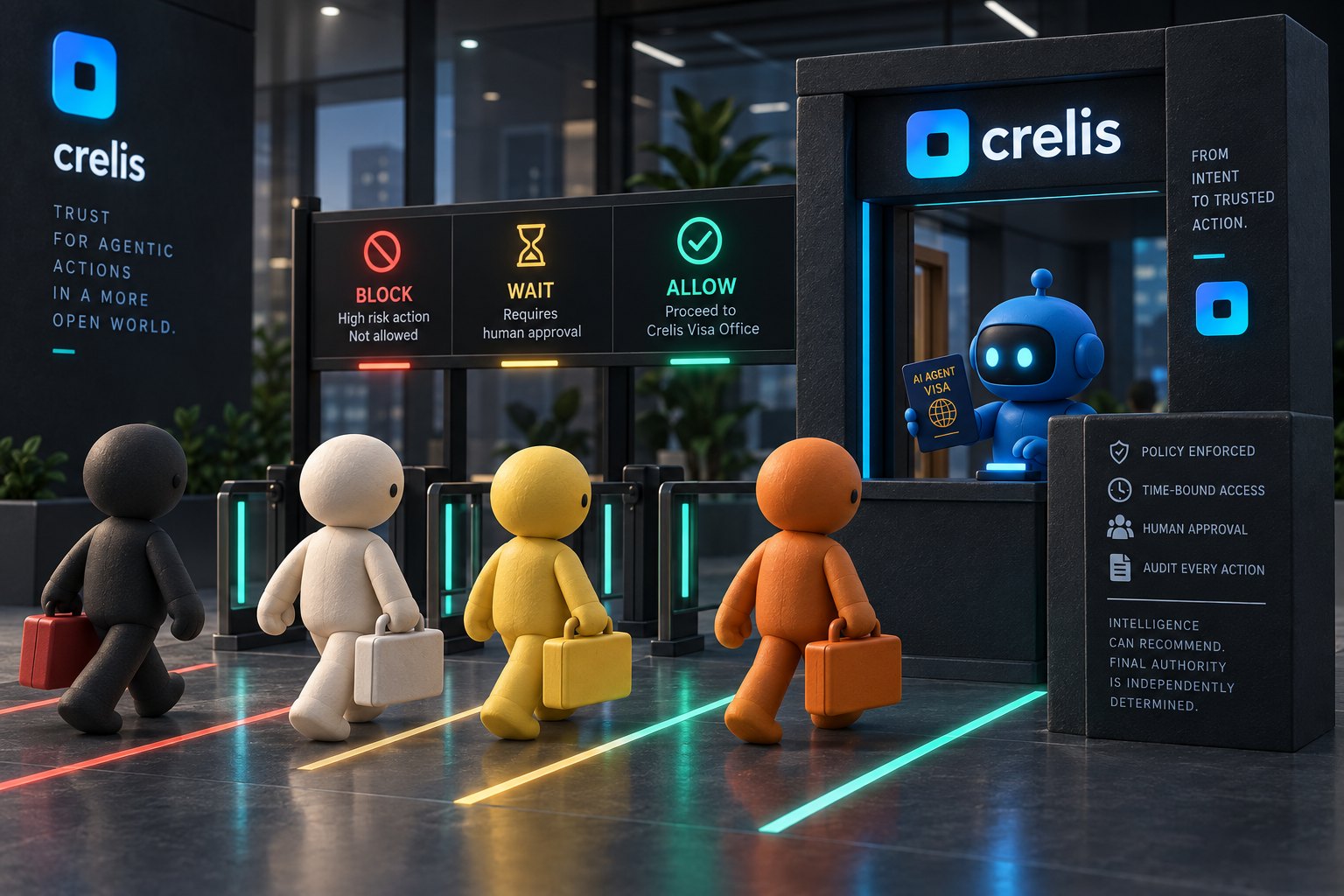
Evaluate each action
Task type, proposed action, amount, industry and channel from the endpoint registration, customer tier, verifications and message signals are evaluated deterministically — before anything executes.
Decide by policy
Policy decides the outcome: allow, require human approval, escalate, or block. Thresholds are yours to set; the final decision is never made by an AI model.
Issue the visa
Allowed actions receive a short-lived, cryptographically signed runtime execution visa. Your system executes; the visa and the evidence make the approval and the execution the same record.
Seal the evidence
Each decision — inputs, policy version, reviewer sign-off, visa — is hashed into a tamper-evident audit trail you can export.
Decision engine
See the decision happen
Pick an action. Watch the inputs evaluated and the policy that fires resolve into a decision — allow, require human approval, escalate, or block. Illustrative data.
Decision engine · deterministic policy evaluation
Illustrative datainteractive
Incoming agent action — select one
Inputs evaluated
- Action
- payment.wire
- Amount
- $250,000
- Industry
- Financial services
- Channel
- Treasury API
- Customer tier
- Corporate
- Verifications
- Counterparty not yet verified
Require human approval
Visa withheld until an authorized reviewer signs off.
Policy WIRE-HIGH fired: amount above the wire threshold and counterparty unverified. Human approval required from a treasury reviewer; visa withheld until sign-off.
Recorded risk context91· context only, not the decider
Human escalation
A checkpoint, not a bottleneck
Require human approval is a first-class outcome. Authorized reviewers see the full context, and their sign-off becomes part of the execution record.
Human approval path
Illustrative data
- 01
AI action
Agent proposes a consequential action
- 02
Deterministic policy
Inputs evaluated; the policy that applies fires
- 03
Require human approval
Outcome when policy calls for sign-off
- 04
Authorized reviewer decides
Full context; sign-off joins the record
- 05
Visa issued or withheld
Signed execution visa; your system executes
- 06
Evidence recorded
Tamper-evident record written
Audit engine
Each consequential action leaves evidence
Who proposed it, which inputs were evaluated, which policy fired, who approved it, what executed — every decision reproducible from its recorded context and exportable for auditors and regulators.
Audit event stream · illustrative
Illustrative datasealed
14:02:11Z · Finance Agent
Proposed wire transfer $250,000 → ACME-7741
14:02:11Z · Crelis
Inputs evaluated · policy WIRE-HIGH fired · REQUIRE HUMAN APPROVAL · risk context 91
14:02:12Z · Crelis
Routed to treasury reviewer pool (2 eligible) · visa withheld
14:06:48Z · Treasury reviewer
Checked counterparty, approved with note
14:06:49Z · Crelis
Execution visa issued · Ed25519-signed, single-use
14:06:49Z · Banking endpoint
Visa verified · wire released — ref TXN-88231
14:06:49Z · Crelis
Evidence recorded · hash 0x91f3…aa07
How this maps to Singapore's MAS SAFR white paper: our breakdown of the records SAFR implies
Governance
One pane for AI activity
Approvals, exceptions, and compliance events across the agents you route through Crelis.
Governance · todayIllustrative data
all policies active
48,212
AI actions today
94.6%
Allowed
2,431
Human approval required
17
Blocked
Open exceptions
- Ops Agent · bulk delete · blocked
- Finance Agent · wire · human approval required
- Compliance Agent · KYC override · escalated
Platform roadmap
Built as an operating system for trusted execution
The trust layer is the foundation. These modules are planned capabilities that extend the core authorization layer.
MCP integrations
In designModel Context Protocol as an integration surface — connectors in design so agent frameworks can route consequential actions through Crelis.
AI agent registry
In designIdentity, permissions, and decision history for each agent you register with Crelis.
Human marketplace
In designOptional, future extension: a pool of authorized reviewers an organisation could draw on when policy requires human approval.
Enterprise dashboards
PilotOrg-wide visibility into AI activity, approvals, exceptions, and spend.
Compliance controls
In designPolicy packs built on over 500 native control templates; mappings to regulatory frameworks are in design.
Audit engine
PilotTamper-evident execution records with cryptographic sealing and export.
Workforce orchestration
In designRouting, SLAs, and quality scoring across authorized reviewer pools.